Guides
Designing a yard setup that will not repeat old technology mistakes
Plan a yard setup that will not repeat old mistakes: watch water before you move it, protect the drinking water source, and design so faults announce themselves.
A setup that avoids repeating mistakes is designed around two ideas: nothing is added until the underlying condition is understood, and every likely failure has a way of announcing itself. Neither idea requires expensive hardware. Both require an hour outside in the rain and a willingness to write things down before shopping.
What to take away
- Walk the property during rainfall before designing anything that moves water.
- Design so faults are visibleflow alarms, inspectable overflows, and labeled shutoffs.
- Know whether your site sits above or near a drinking water source, because that changes what belongs in the yard.
- Leave the record behind, so the next person does not solve the same problem twice.
Step one: watch the water before you touch it
Simplest planning exercise is most skipped. EPA's archived homeowner guidance on what you can do to soak up the rain opens with that instruction.
Storm Walk: Watch Where Water Goes
- Walk the yard during the next rain
- Note where water soaks in
- Note where it crosses the lawn
- Trace downspout flow to storm drain
- Decide what cuts runoff
- Repeat in light and heavy rain
Next rain, walk, watch where water goes. It may soak in, cross a lawn, or run from a downspout down a driveway to a storm drain. Then decide what could cut runoff from the property.
It lists the usual responses: redirecting downspouts, capturing roof water, planting a rain garden, planting trees, reducing hard surfaces, and green roofs. The page carries an EPA notice that this section is no longer updated, so confirm current design guidance locally before building anything from it.
Do that walk twice, in a light rain and a heavy one. The heavy one shows you where the design has to work.
Step two: know what is downstream and underneath
Some yards sit where mistakes reach farther than a wet lawn. USDA Natural Resources Conservation Service says source water protection covers actions to safeguard rivers, streams, lakes, and reservoirs. It protects springs and groundwater that supply public drinking water systems and private wells.
Is Drinking Water Downstream?
Are you on a private well or in a wellhead protection area?
fuel, chemical, and runoff rules change
standard local design guidance applies
A 2018 Farm Bill provision directs the agency to identify local priority areas for drinking water protection in each state. It works with state technical committees and community water systems.
If you are on a private well, or inside a wellhead protection area, the calculus for storing fuel, applying chemicals, or infiltrating runoff changes. Your state drinking water program or county health department can tell you which applies.
Step three: design so failures speak
Likely failure / Make it announce itself
- Underground irrigation leak
- Flow monitoring with an abnormal-use alarm
- Blocked infiltration area
- An overflow you can see, not a buried pipe
- Seeping valve
- Valve boxes you can open and inspect
- Backflow device fault
- Calendar reminder tied to the required test interval
- Controller offline
- A device that keeps a local schedule and says so
Step four: leave the record
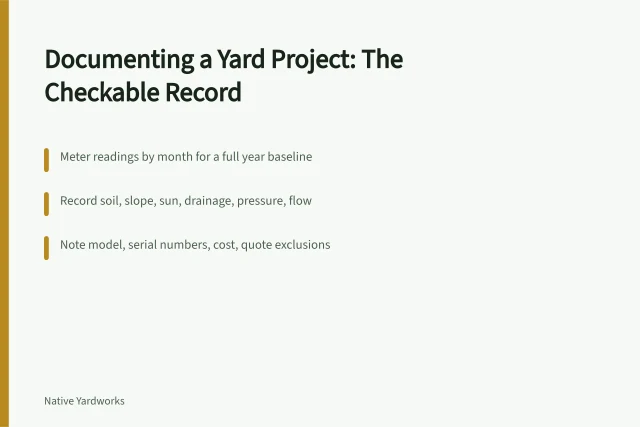
Keep a folder with the site sketch, storm-walk notes, zone numbers, model and serial numbers, and dated photographs. It stops the next project from starting blind.
Combine that with the staging logic in our guide to planning a setup you can extend. Reread the recurring failure patterns in our note on projects that went wrong before finalizing a design.