Rules
Why does questions about the team matter so much for water saving yard products contractor?
How to tell whether an irrigation contractor will diagnose your system or just sell you a controller, including licensing, testing and handover questions.
What to take away
- A contractor who does not measure pressure is guessing at everything downstream.
- Backflow prevention and testing are regulated in most jurisdictions.
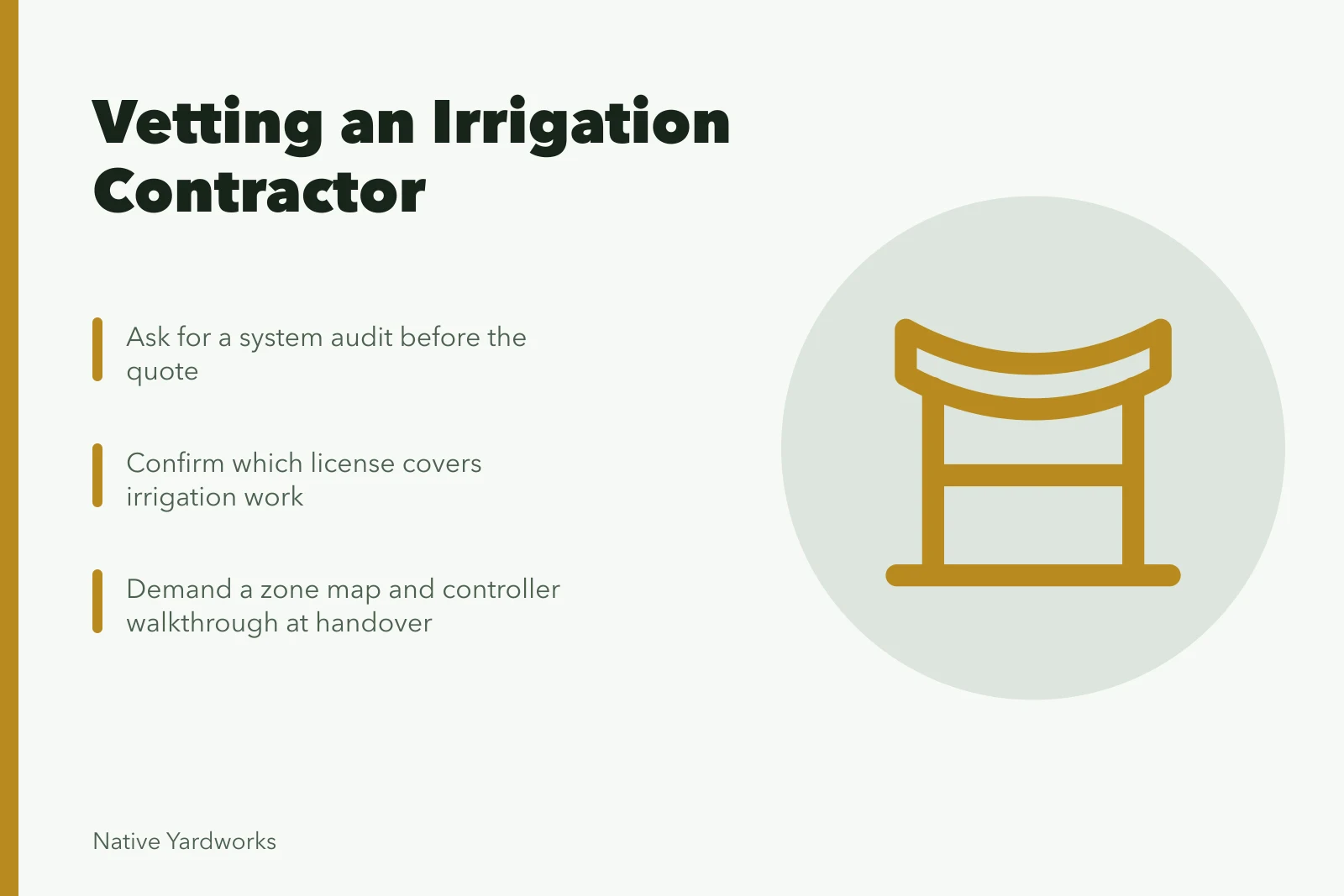
- Ask for an audit before a quote, and expect to pay for it.
- Handover means a zone map, a schedule, and someone showing you the controller.
Questions about diagnosis
- Will you run a system audit before quoting, and what does it include?
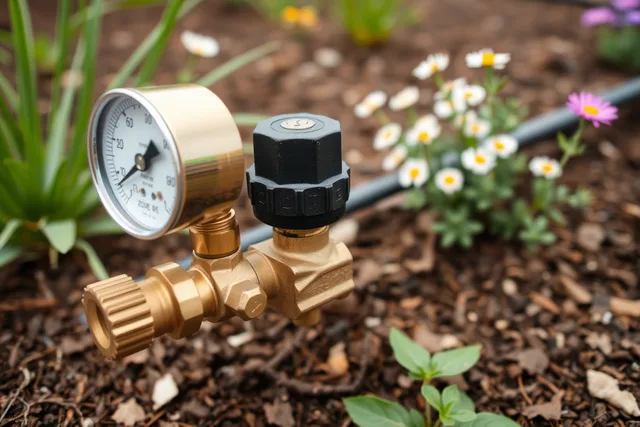
- What static and operating pressure did you measure, and where?
- Which zones are over-watering, and how did you determine that?
- How is the current schedule set, and what would you change first?
An audit with catch-cup testing on spray zones shows a contractor who measures instead of assuming. Catch cups are simple: containers set across a zone, the zone run for a set time, then collected depths compared.
Wide variation means poor coverage. No controller setting fixes poor coverage. It only decides how long dry patches stay dry while wet ones flood.
Questions about credentials
Irrigation work often needs a separate license from general contracting, and backflow assembly testing is usually certified and requires filing.
Ask which license covers this work in your state, who holds it, and whether the backflow test is included and reported to the water provider. An unplanned licensed scope is the surprise that can double a small job.
Water is governed by a web of authorities, not one. USDA's Economic Research Service reports from the 2019 Survey of Irrigation Organizations that western US delivery organizations managed about 70 percent of water withdrawn for irrigation.
They also managed almost 60 percent of withdrawals across agricultural, commercial, industrial and municipal uses in the region.
The residential equivalent is your water provider, and its rules travel with the job.
Questions about the team
Water work spans several disciplines, and good teams say so. The Bureau of Land Management describes an aquatic habitat program staffed with fish biologists, hydrologists and a water rights specialist working together on riparian restoration.
Scaled to a yard: ask who does the hydraulic calculation, who does the wiring, and who programs the controller, because those are frequently three different people.
Questions about products
| Ask | Why |
|---|---|
| Which specific models, and why these? | Rebate eligibility and repairability |
| Are parts available locally? | Emitters and nozzles fail; you will need spares |
| Does anything require a subscription? | A service that ends should not stop the watering |
| Pressure-compensating emitters on slopes? | Otherwise the bottom of the run floods |
| What filter, and what maintenance interval? | Clogging is the main drip failure mode |
Questions about handover
Ask for a zone map showing what each valve waters, the programmed schedule in writing, the seasonal adjustment method, and a walkthrough at the controller with you present.
Ask what happens in month one: who returns to adjust the schedule once plants and weather are observed. A system commissioned in April on April weather will be wrong by July.
A contractor who plans one follow-up visit is worth more than one promising phone support. Price it like aftercare: visits, months covered and what happens on each.
Ask for the zone map as a file as well as a drawing, and keep a copy taped inside the controller cabinet. The next person to work on this system, including a future owner, will start from that sheet.
Combine these with the general screening in the contractor vetting guide and the buying criteria in the water product review framework.