Rules
Part of Building a plan for native yard makeovers case studies: choosing your model
Framing native yard makeovers rules: ask what support exists
Local rules that shape a native yard makeover: grading, drainage, trees, utilities, irrigation and hardscape all carry local rules. Which ones apply to a whole-yard.
What to take away
- Whole-yard makeovers touch more regulated work than single beds do.
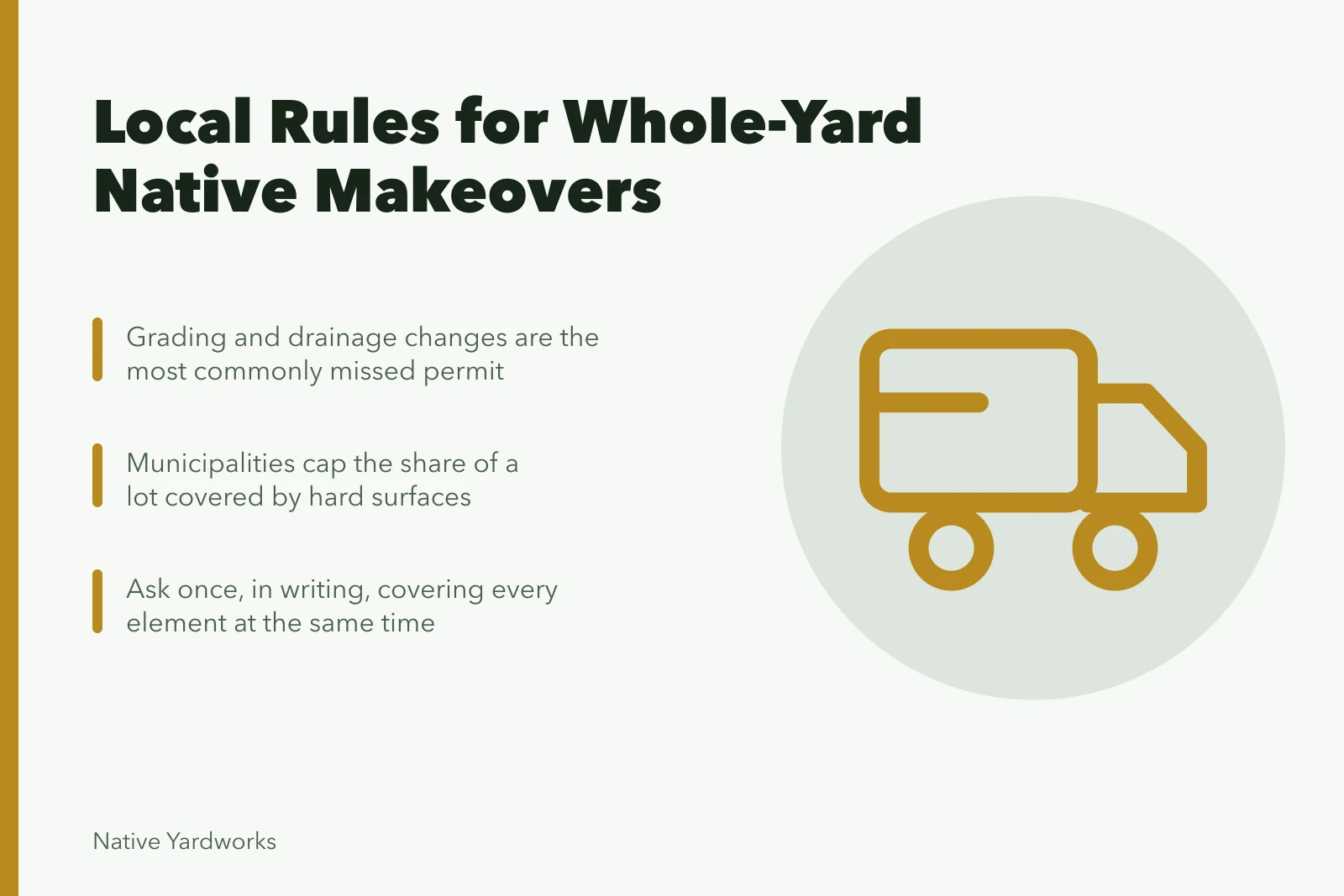
- Grading and drainage changes are the most commonly missed permit.
- Ask once, in writing, covering every element at the same time.
- Public agencies fund and support this kind of work; ask what is available locally.
The elements that usually carry rules
| Element | Typical authority | What they check |
|---|---|---|
| Grading and soil movement | Building or engineering department | Volume moved, drainage changes |
| Drainage and stormwater | Public works or stormwater utility | Where runoff goes, connection to systems |
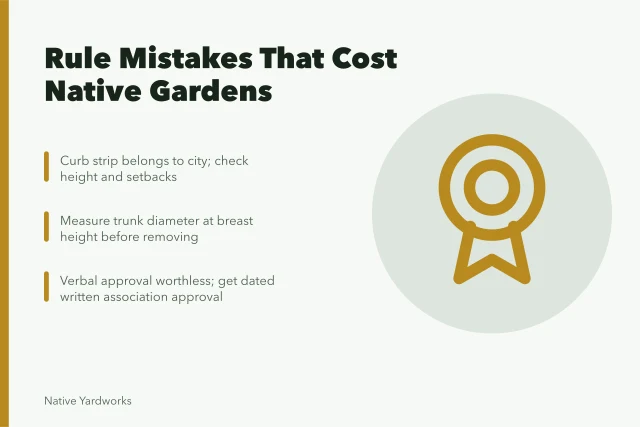
| Tree removal or pruning | City arborist or planning | Trunk diameter, species, protected root zone |
| Irrigation changes | Water utility | Backflow device, meter, testing |
| Hardscape and walls | Building department | Height, footings, impervious area |
| Front yard appearance | Zoning and HOA | Vegetation height, edges, screening |
| Digging anything | Utility locating service | Marked lines before excavation |
Ask about all of them in a single email with a scaled plan attached. Separate questions asked over three months get separate, sometimes contradictory answers.
Who checks what
- Gradingbuilding or engineering department
- Drainagepublic works or stormwater utility
- Tree removalcity arborist or planning
- Irrigationwater utility
- Hardscapebuilding department
- Front yardzoning and HOA
- Diggingutility locating service
Drainage is the one people miss
A makeover often regrades slightly, removes turf that was absorbing water, adds a patio, or redirects a downspout. Each of those changes where water goes, and drainage rules exist because that water ends up on someone else's property.
Does drainage change?
Does the project change the drainage pattern?
get drainage approval before ordering
proceed with grading and plant list
Ask specifically: does this project change the drainage pattern, and if so what approval is needed? Get the answer before ordering materials, because a drainage condition attached to an approval can change the grading, the plant list and the budget all at once.
Impervious area has a budget too
Many municipalities cap the share of a lot that can be covered by hard surfaces, and some charge a stormwater fee based on it. Adding a patio and a path can push a lot over a threshold, which is easier to discover in advance than after pouring concrete.
Permeable options sometimes count differently, and sometimes not at all. Gravel over compacted subgrade may still be counted as impervious in your jurisdiction even though water passes through the stone, so ask how the local rule treats each surface you are considering before choosing between gravel, pavers and concrete.
Ask what support exists
Conversion work is publicly supported in many places, through water utility rebates, stormwater credits, tree planting programs and county conservation district sales. Those district sales are one of the cheapest reliable ways to buy bare-root trees and shrubs.
That pattern runs upward too. The Fish and Wildlife Service describes federal, tribal, state and local governments as key partners in monarch conservation, and says it offers funding and technical resources to support governments and communities in that work. Some of that support reaches households through city and county programs, so ask.
Rules can arrive mid-project
Restrictions are not static, particularly around water. USDA's Economic Research Service notes that the Farm Bill authorizes several programs designed to reduce drought risk, including federal crop insurance and emergency conservation programs, which exist because drought is treated as a recurring condition rather than an exception.
At household level, that means planning for the possibility that watering rules tighten during your establishment period, and asking your utility how new plantings are treated when they do. Ask for the restriction tiers and the notice period in the same call.
Work through the detailed process in the local codes guide and fit the results into whichever of the four makeover models you have chosen.