Industry
Building a plan for native yard makeovers case studies: choosing your model
Four ways to run a native yard makeover, from a weekend volunteer planting to a phased whole-property conversion, with the cost drivers and risks of each.
What to take away
- Labor is the variable that separates these four models, not plant choice.
- A volunteer or self-performed planting can install a lot of plants in one day.
- The long-run saving is mowing, and it is larger than most people expect.
- Every model needs an aftercare owner or it reverts within two seasons.
- These native yard makeover case studies show four models; choosing your model starts with labor, then budget, then patience.
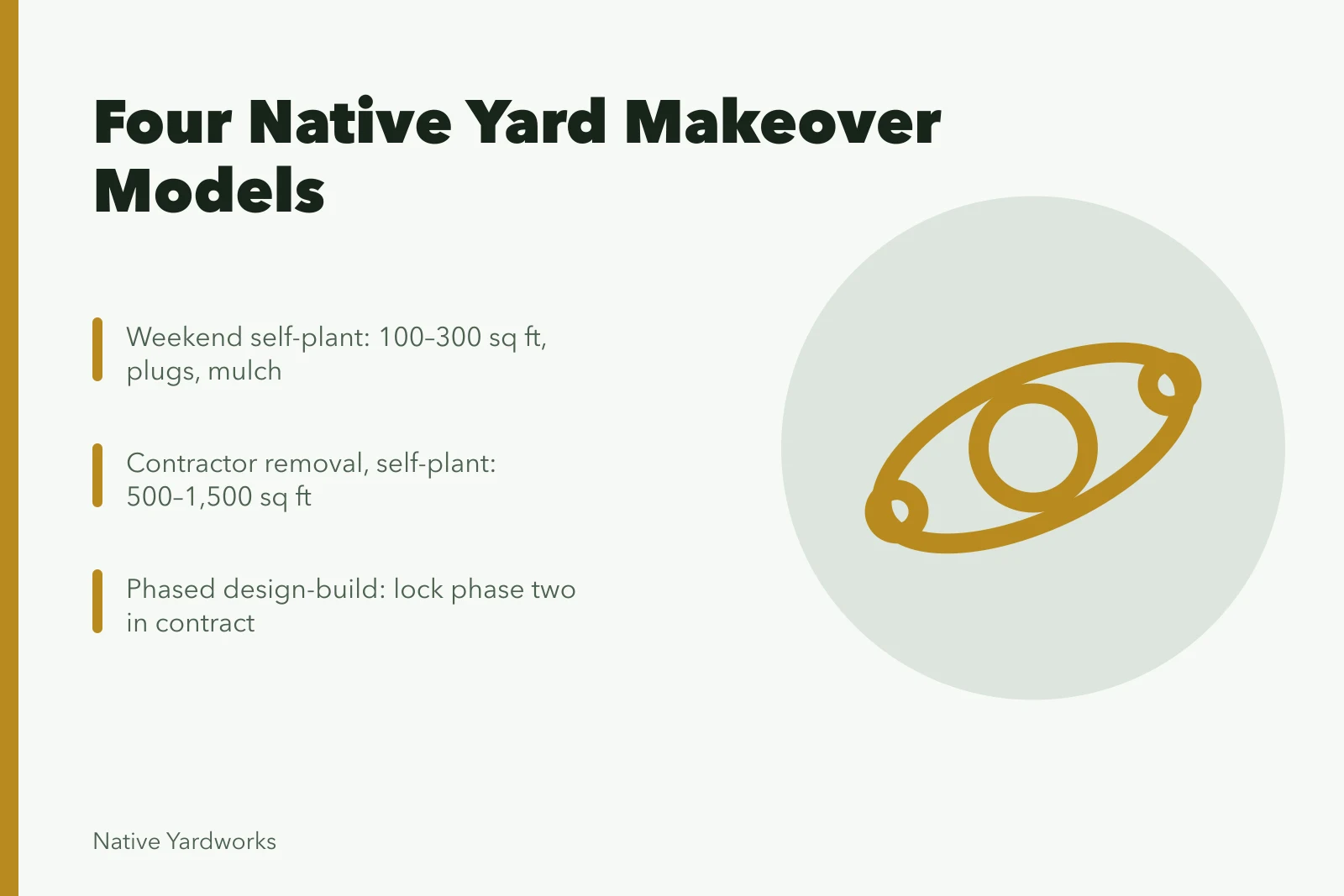
Model one: one weekend, one bed, self-performed, Asheville River Arts District example
Scope: 100 to 300 square feet, sheet mulched the previous season, planted with plugs. Budget dominated by plants and mulch. Risk: underestimating year-one watering.
Volume is achievable when people work together. The Fish and Wildlife Service describes a greenway planting in Asheville, North Carolina where staff and volunteers from several organizations put 2,000 pollinator-friendly plants in the ground on a single Saturday morning.
Lesson: planting is fast. Preparation and aftercare are what take time.
Homegrown National Park, the nonprofit map started by Doug Tallamy and Michelle Alfandari, lists home-scale native plantings across the country. Its advice matches this model: start with one bed, not the whole yard.
In most markets, 100 to 300 square feet of native plugs and mulch typically costs $300 to $1,200. Plugs often run $2 to $5 each, and mulch about $30 to $50 per cubic yard.
Model two: contracted removal, self-performed planting
Scope: 500 to 1,500 square feet. A crew cuts and hauls the sod; you plant plugs and gallons over two or three weekends. Budget split roughly between removal and plants. Risk: the gap between removal day and planting day.
Lesson: agree the handover condition in writing, down to what the site is left like on the last day. Have mulch on site the day the sod leaves.
Spell out the handover condition: graded to the level you asked for, free of sod fragments and debris, and not compacted by machine tracks across the area you are about to plant into.
This model also puts the schedule risk on you rather than the contractor. The crew books a removal date that suits their calendar, and if your plants are not ready or the weather turns, the cleared ground waits. Order the plants before you book the removal, not after. Nothing comes out until the replacement planting is ordered.
The 12,000 Rain Gardens program in Puget Sound, Washington, run by Stewardship Partners and Washington State University Extension, shows how a removal-and-replant sequence scales when many owners follow the same handover rules. It targets 12,000 rain gardens to manage stormwater.
In most markets, removal and hauling typically costs $1 to $3 per square foot. Plants for 500 to 1,500 square feet often add $1,000 to $7,500, depending on spacing and plug size.
Model three: designed and installed, phased over two seasons, Lurie Garden and Lady Bird Johnson Wildflower Center examples
Scope: a full front yard or a large back area. A paid plan, contracted removal and planting, phase one this year and phase two next. Budget adds design and a second mobilization. Risk: phase two never happening.
Lesson: put phase two in the same contract with a fixed price and a date, or it becomes a new project you will not start.
Public projects show the value of a plan. The Lurie Garden in Chicago's Millennium Park covers about 2.5 acres and was designed by Piet Oudolf with Kathryn Gustafson and Robert Israel.
The Lady Bird Johnson Wildflower Center in Austin, Texas, founded in 1982, pairs native display gardens with rainwater collection and plant research.
In most markets, design fees typically run $500 to $3,000 for a residential plan, or 10 to 20 percent of installation. Phasing usually adds one mobilization and delivery per phase, often $300 to $1,000 each.
Model four: whole-property conversion with irrigation work, Mt. Cuba Center and North Carolina Botanical Garden examples
Scope: everything, including drip conversion and drainage correction. Highest budget, longest schedule, largest disruption. Risk: bare ground across the whole lot at once.
Lesson: do site work everywhere in one visit, then plant in sections, covering unplanted ground in the meantime.
Mt. Cuba Center in Hockessin, Delaware, maintains native plant gardens and runs trials of native perennials. The North Carolina Botanical Garden in Chapel Hill holds conservation collections and native plant displays. Both show the model at public scale: site work first, planting in sections.
Drip conversion typically costs $2 to $5 per square foot in most markets. Drainage correction often runs $2,000 to $15,000 depending on slope, soil and outlets. Whole-property conversion can exceed $20,000 in many markets.
Where the savings actually appear
| Saving | Timing | Notes |
|---|---|---|
| Mowing | Immediate | The largest recurring saving in most yards |
| Water | First full summer | Depends on your water price |
| Fertilizer and treatments | Immediate | Often eliminated entirely |
| Replacement plants | After year three | Only if establishment was done properly |
Mowing frequency changes most. A Fish and Wildlife Service account of pollinator plantings on North Carolina solar sites turned the cost argument on this: non-native grasses typically planted there need multiple mowings a month through the growing season.
Native pollinator-friendly plantings, once established, need mowing once or twice a year.
Choosing your model
Pick by labor availability first, then budget, then patience. Most people choose on budget and then discover that the model they picked assumed weekends they do not have. Cost each option against the full project cost breakdown and run whichever you choose through the project planning sequence.