Features
Two ways to run front yard plant combinations ideas: before you buy versus design for a season of bloom
Twelve native front-yard planting recipes built from roles rather than shopping lists, with the regional species that usually fill each role.
What to take away
- Front yard plant combinations work as a set of rolesstructure, matrix, seasonal accent, ground layer.
- Repeat three to five species in groups instead of collecting twelve singles.
- Keep bloom running from early spring to frost so something is always working.
- Every recipe below needs a regional species check before you buy anything.
Build from four roles
Front-yard planting that reads as deliberate almost always has the same skeleton. One or two structure plants give winter form. A matrix of grasses or sedges fills the space between everything else. Two or three flowering species repeat through the matrix. A ground layer closes the soil.
Four planting roles
Role
- Structure plants
- Winter form
- Matrix
- Fills between
- Flowering species
- Repeat through matrix
- Ground layer
- Closes the soil
Job in the bed
- Structure plants
- One or two
- Matrix
- Grasses or sedges
- Flowering species
- Two or three
- Ground layer
- Low cover
Get the roles right and the species list becomes flexible, which matters because the right species for a Denver curb strip and a Charlotte curb strip share nothing but the job description. The same six roles can be filled in any region, which is why buying roles beats buying names.
Twelve front-yard recipes, with the plants named
Twelve front-yard recipes
| Recipe | Site | Named species and why |
|---|---|---|
| 1. Sunny curb strip | Hot, salted, walked on | Blue grama (Bouteloua gracilis), 12 to 18 inches, low water and reflected heat; purple lovegrass (Eragrostis spectabilis), 12 to 24 inches, pink seed heads in late summer; no woody plants. |
| 2. Foundation band | Half day sun, dry at the wall | Dwarf fothergilla (Fothergilla gardenii), 2 to 3 feet, white bottlebrush flowers in spring; little bluestem (Schizachyrium scoparium) 'Standing Ovation', 3 to 4 feet, blue summer foliage; wild hyacinth (Camassia scilloides), 12 to 18 inches, April bulb for the wall layer. |
| 3. Shaded north bed | Cool, damp, root competition | Pennsylvania sedge (Carex pensylvanica), 6 to 12 inches, spreads into a dry-shade mat; Christmas fern (Polystichum acrostichoides), 1 to 2 feet, evergreen; Virginia bluebells (Mertensia virginica), 1 to 2 feet, April bloom, dormant by July. |
| 4. Entry pair | Framing the walk | Inkberry (Ilex glabra) 'Compacta', 3 to 4 feet, evergreen and clump-forming, planted as a matched pair; wild strawberry (Fragaria virginiana), 4 to 6 inches, spreads by runners underneath. |
| 5. Dry slope | Erosion, runoff | Sideoats grama (Bouteloua curtipendula), 2 to 2.5 feet, deep fibrous roots; prairie smoke (Geum triflorum), 6 to 12 inches, mat-forming, pink nodding seed heads in late spring. |
| 6. Downspout basin | Wet then dry | Palm sedge (Carex muskingumensis), 2 to 3 feet, wet to average soil; cardinal flower (Lobelia cardinalis), 2 to 4 feet, July to September bloom, a hummingbird plant. |
| 7. Mailbox planting | Full sun, no watering | Butterfly milkweed (Asclepias tuberosa), 1 to 2 feet, orange June to August bloom and a deep taproot; buffalo grass (Bouteloua dactyloides), 4 to 6 inches, low warm-season turf; gravel mulch. |
| 8. Under a mature tree | Dry shade | Appalachian sedge (Carex appalachica), 6 to 10 inches, dry shade; bloodroot (Sanguinaria canadensis), 6 inches, March to April bloom, dormant by summer; leaf mulch. |
| 9. Narrow side yard | One-sided light | Viburnum nudum 'Winterthur', 5 to 6 feet, upright with glossy leaves; Ohio sedge (Carex radiata), 12 to 18 inches, clump-forming; gravel path. |
| 10. Meadow patch with a mown frame | Open sun | Little bluestem and prairie dropseed (Sporobolus heterolepis), 2 to 3 feet, matrix grasses; butterfly milkweed, purple coneflower (Echinacea purpurea), wild bergamot (Monarda fistulosa), and stiff goldenrod (Solidago rigida), 2 to 5 feet, midsummer to fall forage; mown border. |
| 11. Hummingbird corner | Morning sun | Cardinal flower (Lobelia cardinalis), 2 to 4 feet, red tubular bloom July to September; red buckeye (Aesculus pavia), 8 to 12 feet, spring tubular bloom; shallow water dish. |
| 12. Winter-interest bed | Visible from the street | Little bluestem seedheads, held into winter; Pennsylvania sedge (Carex pensylvanica), semi-evergreen; red osier dogwood (Cornus sericea) 'Baileyi', 6 to 9 feet, red winter stems. |
Fill each role with species native to your region, and check mature width before you commit. Which recipe suits also depends on the conditions that change within a single lot, since a baking wall and a shaded north bed can sit twenty feet apart.
Design for a season of bloom, not a week
Pollinators need forage across the whole season, not one big June show. The Fish and Wildlife Service's pollinator initiative is plain that populations are declining and that building a native pollinator garden in your own yard counts as conservation action.
USDA notes that three-fourths of the world's flowering plants and about 35 percent of food crops rely on animal pollinators, and that more than 3,500 species of native bees help increase crop yields. A front yard with something in flower from March to October does real work.
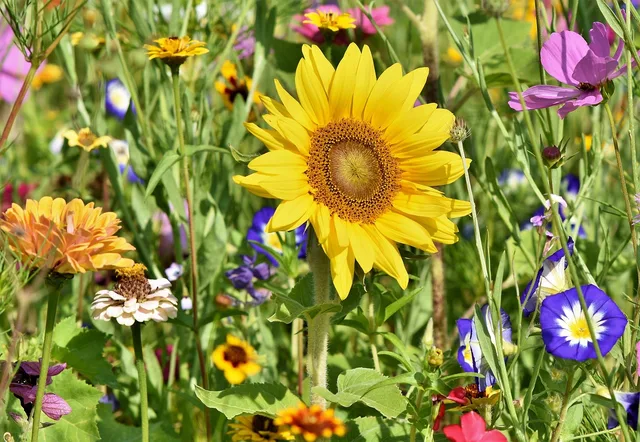
Aim for at least three bloom windows: early spring, midsummer, and late summer into fall. Virginia bluebells and bloodroot cover April; purple coneflower and wild bergamot cover July; stiff goldenrod and New England aster (Symphyotrichum novae-angliae) carry September into October.
Make it read as intentional
Front yards are judged from the sidewalk in four seconds. Three habits do most of the work:
- repeat plants in odd-numbered groups rather than dotting singles;
- keep one clean edge facing the street, mown, bordered or paved;
- hold the tallest material back from the walk so sightlines stay open.
Before you buy
Take the recipe you like, write the four roles, then find your regional species for each. Work through the first-step checklist and confirm the fundamentals in the site-first planning guide before ordering.
Common questions
How many species should a front bed have?
Can I mix natives and non-natives?
What is a matrix?
Do I need a lawn strip in front?
In this guide
- 5 things to weigh up on front yard plant combinationsFive checks decide whether a front yard plant combination works, covering water, soil, height, bloom timing and the rules your city enforces.
- 5 things worth knowing about homeowners front yard plant combinationsFourteen questions that tell you whether a designer or crew can actually deliver a native front yard, and the paperwork to ask for before signing.
- US Homeowners: Four Native Front-Yard ChoicesUS homeowners weigh four native front-yard choices: formal or naturalistic design, plugs or larger stock, straight species or cultivars, and phased planting.
- Front yard planting checklist: 8 steps before you buyBefore you shop for front yard plant combinations, work this checklist of eight steps: draw the site, find the right-of-way, dig the soil, test one bed.
- 6 takeaways on front yard plant combinationsFront yard plant combinations problems and their fixes: scattered species, floppy perennials, bare soil, weeds that return, a dead corner, and a messy edge.