Rules
Part of Building a plan for native yard makeovers case studies: choosing your model
Untangling native yard makeovers contractor: before you sign
Screening a contractor for a large conversion: credentials, plant sourcing, site work, irrigation, phasing and who comes back after the planting is done.
What to take away
- A whole-yard job needs more trades than a bed, so ask who does each part.
- Sourcing is the difference between the plan you approved and the yard you get.
- Phasing has to be in the contract, with a price and a date for phase two.
- Follow-up visits are the scope item most often quietly dropped.
Ask who performs each scope
Who does which scope
- Removal and disposal
- Grading and drainage
- Hardscape
- Irrigation modification
- Tree work
- Herbicide application
- Planting and maintenance
A single general contractor coordinating specialists is fine. A single crew claiming all of it is a risk, and the risk shows up in the parts that need a license.
Ask about plant sourcing in detail
- Which growers, and how far in advance do you order?
- Straight species or cultivars, and why for each?
- What is your substitution rule, and does it require my written approval?
- Who checks the delivery against the list before planting?
Identification skill is the underlying competence here, and it is a formal discipline. USDA publishes taxonomic keys for field classification of soils for exactly that reason: field decisions get better when there is a published standard behind them. Ask your contractor what they use to confirm plant identity.
Ask how the site work will be sequenced
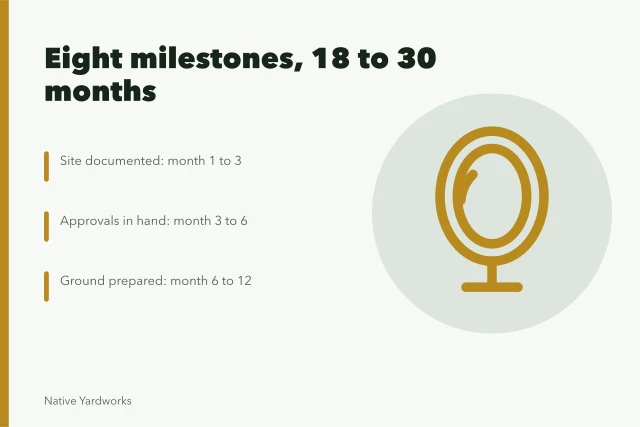
For a large conversion the order matters more than the individual steps: utility locating, drainage correction, grading, hardscape, irrigation rough-in, soil preparation, planting, mulch, labels. Hold each of those against the eight milestones and what has to be true before each one.
Ask what happens to the ground between milestones. The answer should always include how it stays covered.
Ask about protection too. Which trees get fencing at the root zone, where the equipment route runs, and what protects the driveway and the lawn you keep.
Tree work and grading carry their own local approvals on a whole-yard job. Compaction and root damage are two quiet harms a large project causes, and neither shows on a punch list because neither is visible on the last day.
Ask what happens after planting day
Follow-up is where large projects fail. Establishment care is months of unglamorous visits, and it is the first thing dropped when a crew gets busy.
Sustained attention is what makes plantings succeed. The Fish and Wildlife Service describes college students beginning a semester-long service commitment with a day at an Asheville pollinator garden, which is the shape aftercare actually takes: repeated visits over months, not a single installation event.
Get the visit count, the months covered, and what happens on each visit written into the contract.
The bid comparison table
Bidder A
- Removal method and disposal
- Plant list matched to yours
- Irrigation scope and license
- Phase two price and date
- Establishment visits included
- Replacement terms
- Exclusions
Bidder B
- Removal method and disposal
- Plant list matched to yours
- Irrigation scope and license
- Phase two price and date
- Establishment visits included
- Replacement terms
- Exclusions
Bidder C
- Removal method and disposal
- Plant list matched to yours
- Irrigation scope and license
- Phase two price and date
- Establishment visits included
- Replacement terms
- Exclusions
Fill it in yourself. If a column has blanks, that bidder has not priced your project.
Before you sign
Visit a three-year-old job by the same crew. Apply the general screening in the contractor vetting guide, and confirm the scope matches whichever of the four makeover models you are actually buying.