Features
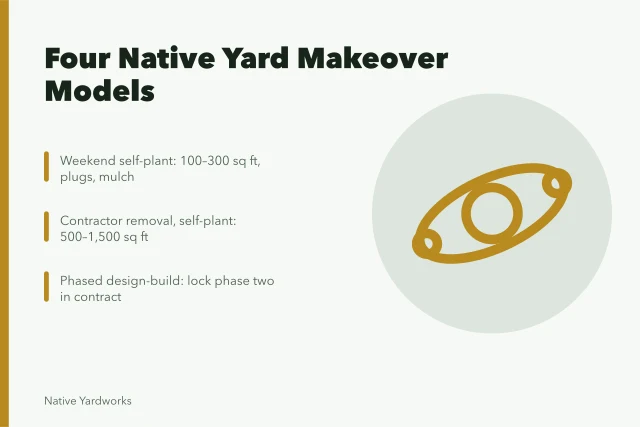
Part of Building a plan for native yard makeovers case studies: choosing your model
Guide to native yard makeovers timeline: the eight milestones
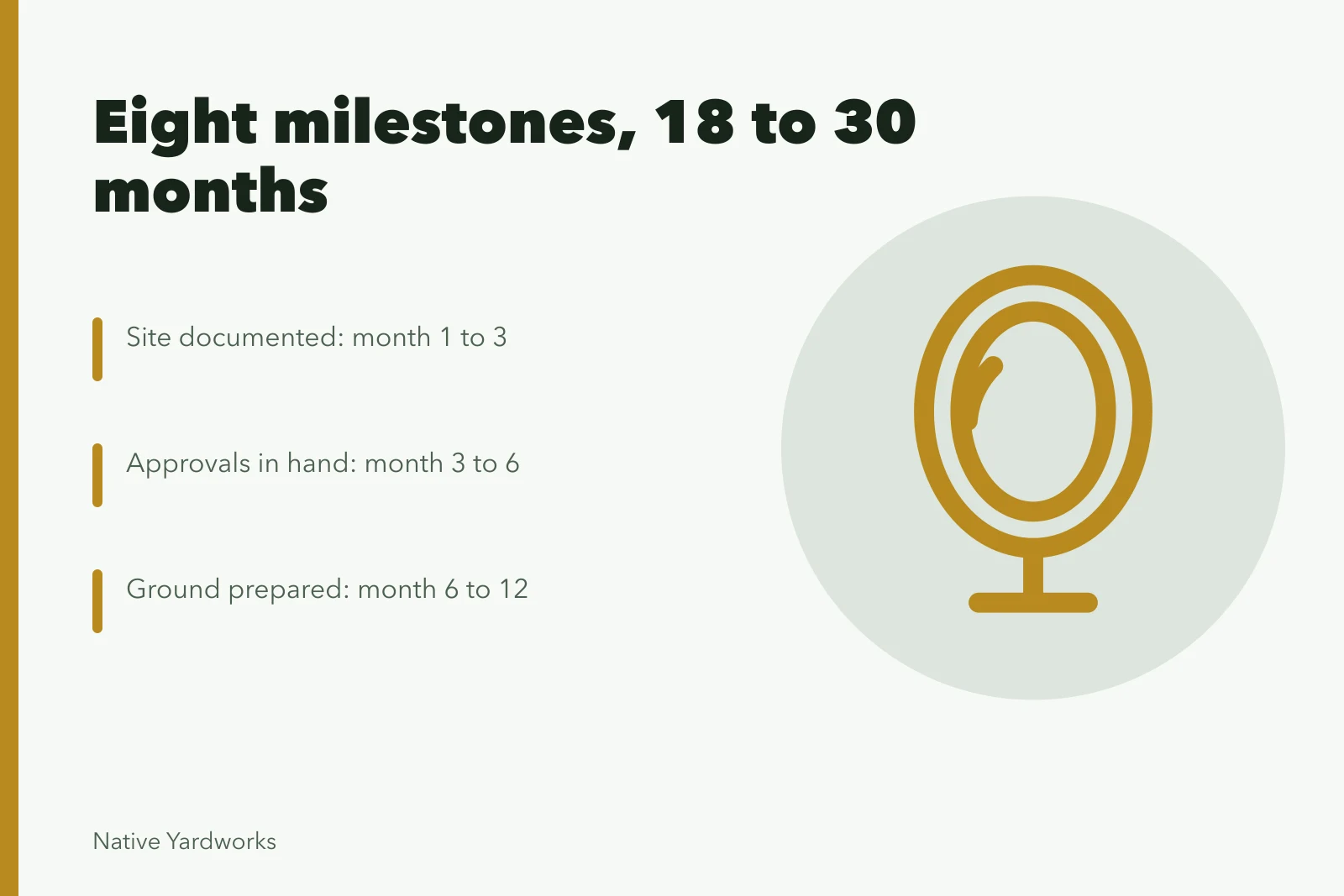
Eight milestones from first measurement to a finished planting, with what has to be true before each one and how long the gaps between them really run.
What to take away
- A whole-yard makeover is an 18 to 30 month project, not a summer one.
- Approvals and plant ordering happen long before anything is removed.
- Preparation is a phase with its own duration, not a day of work.
- The last milestone is two seasons after planting, not planting day.
The eight milestones
| Milestone | Typical timing | Must be true first |
|---|---|---|
| 1. Site documented | Month 1 to 3 | Sun, drainage, soil and obstacles recorded |
| 2. Goal and budget fixed | Month 3 | One sentence and a number |
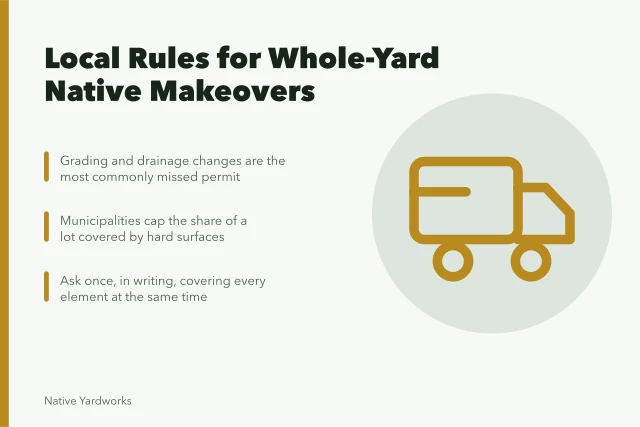
| 3. Approvals in hand | Month 3 to 6 | Plan submitted, rules confirmed in writing |
| 4. Plants ordered | Month 4 to 6 | Final plant list with counts and sizes |
| 5. Ground prepared | Month 6 to 12 | Removal method matched to the vegetation |
| 6. Planting complete | The regional window | Plants on site, mulch staged, water available |
| 7. Establishment done | Month 18 to 24 | Two seasons of watering and weeding |
| 8. Reviewed and adjusted | Month 24 to 30 | Survival counted, gaps replanted |
Why the gaps are longer than they look
Milestones 3 and 5 are the ones that stretch. Approvals wait on meeting cycles. Preparation waits on a season passing under cover, or on a second herbicide pass, or on the ground drying enough to work.
Which milestones stretch and why
Milestone
- Approvals
- Meeting cycles
- Ground prep
- A season under cover
- Ground prep
- Second herbicide pass
- Ground prep
- Ground drying to work
- Plants ordered
- Nursery availability, not calendar
What it waits on
- Approvals
- Ground prep
- Ground prep
- Ground prep
- Plants ordered
Neither can be compressed by wanting it more, and both fail loudly if rushed.
Milestone 4 has a different problem: it is easy and therefore gets postponed. Ordering plants feels like something that can wait until the ground is ready, and by then the straight species you specified are committed to somebody else's project.
Availability sets the schedule rather than the calendar, which is what documented plantings do differently. Order against the plan, not the state of the site, and accept that the boxes may sit in a shaded corner for a few weeks before they go in.
Long horizons are normal in land work
Change in vegetation is slow, and the work is planned that way. The Fish and Wildlife Service quotes a Vermont refuge forester looking at a stand of almost entirely balsam fir and calling that a problem, because the decisions being made now are about what the forest looks like decades later.
Institutional support reflects the same timescale. USDA's National Agroforestry Center traces its origins to the 1990 Farm Bill, a reminder that programs behind tree and vegetation work are measured in decades rather than seasons.
Scheduling around the planting window
Work backwards from the window, not forwards from today. If your region plants in fall, ground preparation runs through summer, plants are ordered in spring, approvals are sought over winter, and site documentation happens the year before.
If a milestone slips, hold at the previous one rather than compressing the next. A project paused with the ground covered is fine. A project rushed into a July planting is not, and the difference usually shows up as a replacement order the following spring. If the energy runs out mid-way, stop at a defensible boundary and mulch the rest.
What "finished" means
Finished is when survival has been counted twice, gaps have been replanted once, watering has dropped to heat waves only, and the weeding time has settled to something you would do anyway.
Cross-check the sequence against the general project timeline, and size the whole thing with the four makeover models.