Maintenance
Part of Building a plan for native yard makeovers case studies: choosing your model
Auditing native yard makeovers lessons: losing access
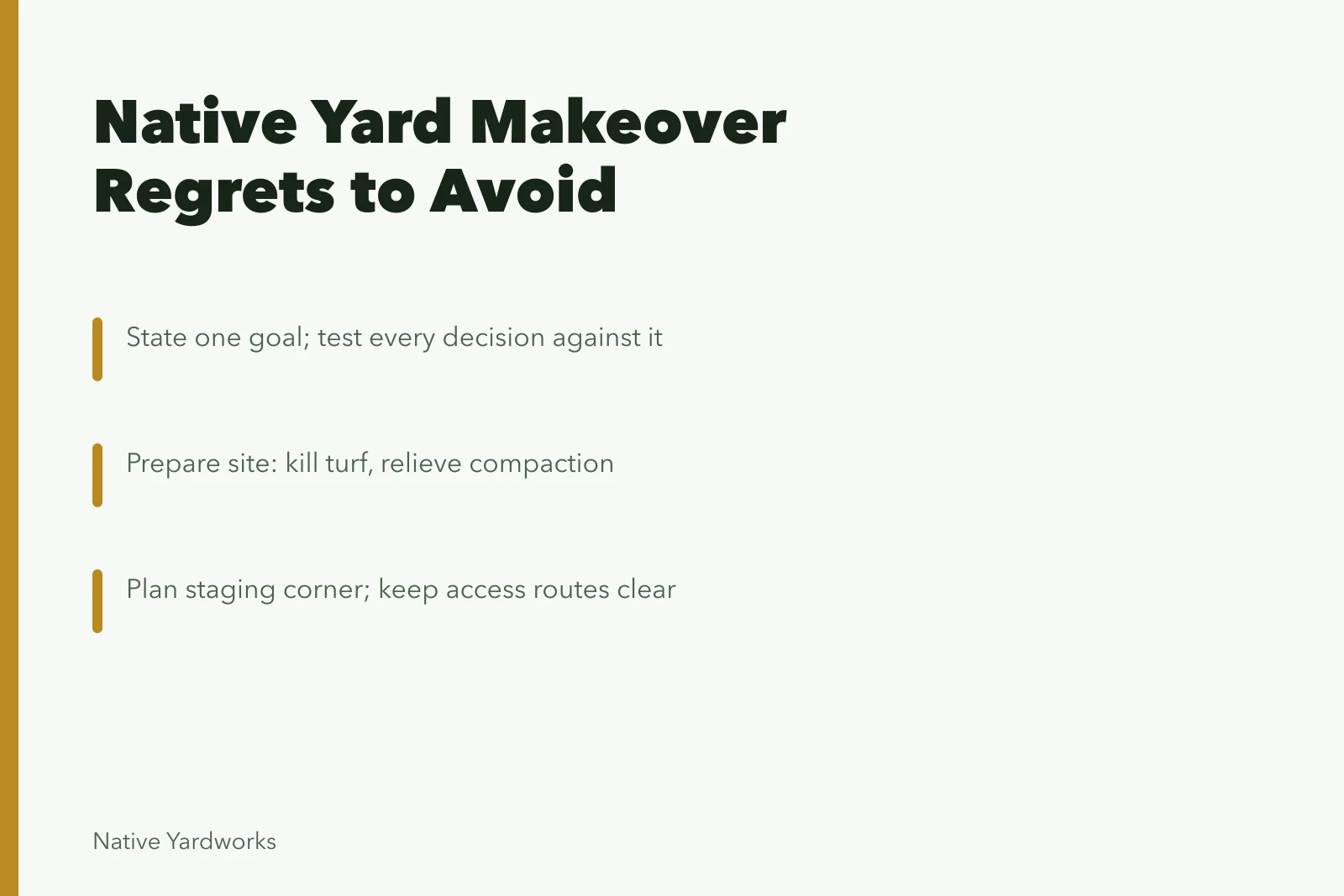
Regrets specific to whole-yard conversions: no stated goal, weak site preparation, blocked access, no staging area and aftercare nobody agreed to own.
What to take away
- A makeover without a stated goal becomes a collection of unrelated beds.
- Site preparation is invisible in photographs and decides the outcome anyway.
- Losing access for equipment, bins and deliveries is a daily irritation.
- Patience is the scarcest resource, and small plants are the usual casualty.
Regret: no goal anyone can state
"Make the yard nicer" yields a new patio, three unrelated beds, and a bare strip nobody planned. A stated goal sounds like: reduce mowing to one small area, keep the play surface, make the front look kept in winter.
Vague goal vs stated goal
Vague goal
- Mowing
- unspecified
- Play surface
- lost
- Winter front
- bare strip
- Beds
- three unrelated
Stated goal
- Mowing
- one small area
- Play surface
- kept
- Winter front
- looks kept
- Beds
- one theme
A small makeover with a clear theme beats a large one with none. That is why the entry bed or the downspout corner is a good first target.
Write it in one sentence and test every decision against it. The sentence is also what you hand to a designer or a contractor, and it does more to shape a good bid than three pages of description.
Regret: rushing the preparation
Preparation is where the money is least visible and most consequential. Big projects treat it as its own phase.
The Fish and Wildlife Service describes former agricultural fields at a Washington refuge being prepared for new life as native wetland prairie habitat, using fire as one of the tools, before anything is expected to look finished.
At home this is less dramatic and just as necessary: kill the turf properly, relieve compaction where equipment ran, fix the drainage, then plant. A spot that stays saturated afterwards is usually a compacted or slowly permeable layer rather than an emitter fault.
Regret: losing access
A whole-yard makeover can accidentally remove the route the trash bins take, the path to the meter, the place a ladder goes, or the corner where firewood was stacked.
Walk the yard listing what has to keep working, then design around those routes. Restoring access afterwards means moving plants that have just settled in.
Regret: no staging area
Deliveries of plants, mulch and stone need somewhere to sit that is not the planted area. Plan a staging corner on a tarp, and keep it out of the beds.
The default staging area is the flattest, closest spot to the driveway: usually the lawn you meant to keep. A few tons of stone for three weeks compacts soil badly. The grass never fully recovers, and the ground stays hard for years.
Choose the staging spot deliberately. Put plywood or a tarp under anything heavy, and pick a corner you planned to dig up anyway.
Regret: impatience with small plants
Small stock looks like nothing for a season and then outperforms larger stock. People replace it before it gets the chance.
The Fish and Wildlife Service's note on the Texas prairie dawn-flower makes the point that small plants can be exactly the ones that matter.
The flower is a tiny endangered relative of the sunflower. It grows only on the salty bare soils of Texas grasslands and blooms between February and April.
Regret: aftercare nobody agreed to own
Question / Answer it now
- Who waters, and on what test?
- A name and a method
- Who weeds, and how often?
- A day of the week
- What happens in August holidays?
- A backup person
- Who decides on replacements?
- One person, once a year
- Where are the records kept?
- One file, one place
Compare these against the regrets reported about native plantings generally, and re-check the scope of whichever of the four makeover models you chose.