Industry
Part of How to judge a native plant for your own yard: ecoregion, habitat and upkeep
Regional native plants case studies: one Oregon prairie
Regional native plants case studies examine one Baskett Slough prairie, its documented flora and home-garden lessons, plus a Sonoran seed-collection example.
What to take away
This regional native plants case studies article centers on one Oregon prairie restoration and draws practical lessons for a home garden, with a separate Sonoran seed-collection example.
- Habitat types can be almost gone locally, which raises what a small planting is worth.
- Grasses plus many wildflowers is the structure that documented restorations use.
- Host plant relationships are specific, so one species can carry another.
- Seed is collected by hand, plant by plant, which explains price and lead time.
Lesson one: local scarcity changes the stakes
Some habitat types survive only in fragments.
A Fish and Wildlife Service story from Oregon's Baskett Slough refuge in the Willamette Valley records native prairie there at less than one percent of its historic range. A never-plowed remnant patch sits beside a former farm field restored to prairie in 2014.
The homeowner reading of that: in a region where a habitat type is nearly gone, a few hundred square feet of the right plants is not a token gesture. It is a meaningful fraction of what remains nearby.
Lesson two: a couple of grasses and dozens of wildflowers
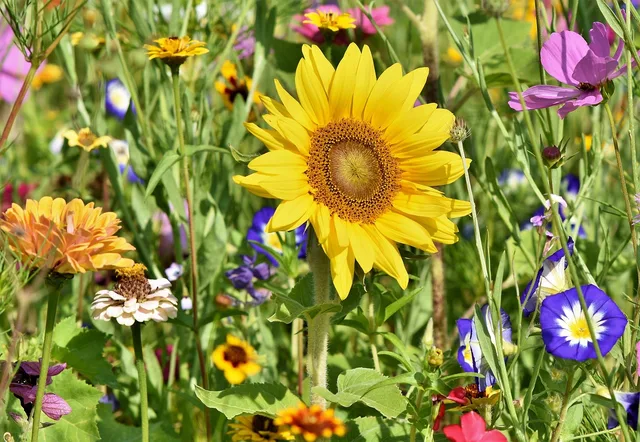
The same restored field was planted, in the refuge manager's description, with a couple of native bunch grasses and dozens of native wildflowers. That ratio is worth copying: few grass species, repeated heavily to form the matrix, with wide flowering diversity spread through them.
The refuge's prairie flora at Baskett Slough includes Kincaid's lupine, camas, golden paintbrush, and Oregon grape among examples found in native prairie habitats being restored.
Restoration Ratio vs Home Planting
Restoration planting
- Grasses
- Few species, heavy
- Wildflowers
- Dozens of species
- Structure
- Matrix holds bed
- Ground
- Covered year-round
- Order
- Grasses first, plugs
Typical home bed
- Grasses
- None or one
- Wildflowers
- One of everything
- Structure
- Collapses in August
- Ground
- Bare by March
- Order
- Perennials fill bed
Home plantings usually invert it, buying one of everything that flowers and nothing that holds the structure together. The result is familiar: a bed that looks busy in June, collapses in August, and is bare ground by the following March.
The correction is cheap because grasses are cheap. Buy the matrix species as plugs in quantity. Plant them first at even spacing across the whole bed.
Then set the flowering plants into the gaps in repeating groups. Plugs are the right size for that job, and larger stock earns its price only where the eye lands. That order stops you from filling the bed with perennials and leaving no room for the plants that hold them up.
Lesson three: specific plants carry specific species
At Baskett Slough, the remnant prairie supports Kincaid's lupine, which is the host plant for the endangered Fender's blue butterfly. That is a one-to-one dependency: no host plant, no butterfly.
Ask your regional native plant society which host plants matter locally. In Oregon, the Native Plant Society of Oregon is a named starting point; in Arizona, try the Arizona Native Plant Society. Adding one host species does more measurable good than adding five generic nectar plants.
Lesson four: seed comes from people in the field
Native seed is not manufactured. The Bureau of Land Management describes botanists hand-collecting seed across the Sonoran Desert to lay the groundwork for later habitat restoration, working through the season in the field.
The Sonoran Desert example shows the fieldwork behind regional seed collection, but it does not establish a home-garden price or lead time. Ask a grower where seed was collected and whether the offering is a straight species; choosing a straight species rather than “something similar” preserves the regional identity you sought.
Lesson five: records outlast people
| What documented projects keep | Home equivalent |
|---|---|
| Species list with source and quantity | Your spreadsheet |
| Installation date and method | A line in the plan |
| Monitoring photos over years | Same view, same month, every year |
| Notes on what failed and why | Two sentences each spring |
Restoration sites are monitored for years because early results mislead. A planting that looks poor in year two often looks right in year four, and the only way to know which is which is a record.
Records to Keep at Home
- Species list with source and quantity
- Installation date and method
- Monitoring photos, same view monthly
- Notes on what failed and why
Apply these lessons to a home yard, then choose species with the regional comparison frame.